

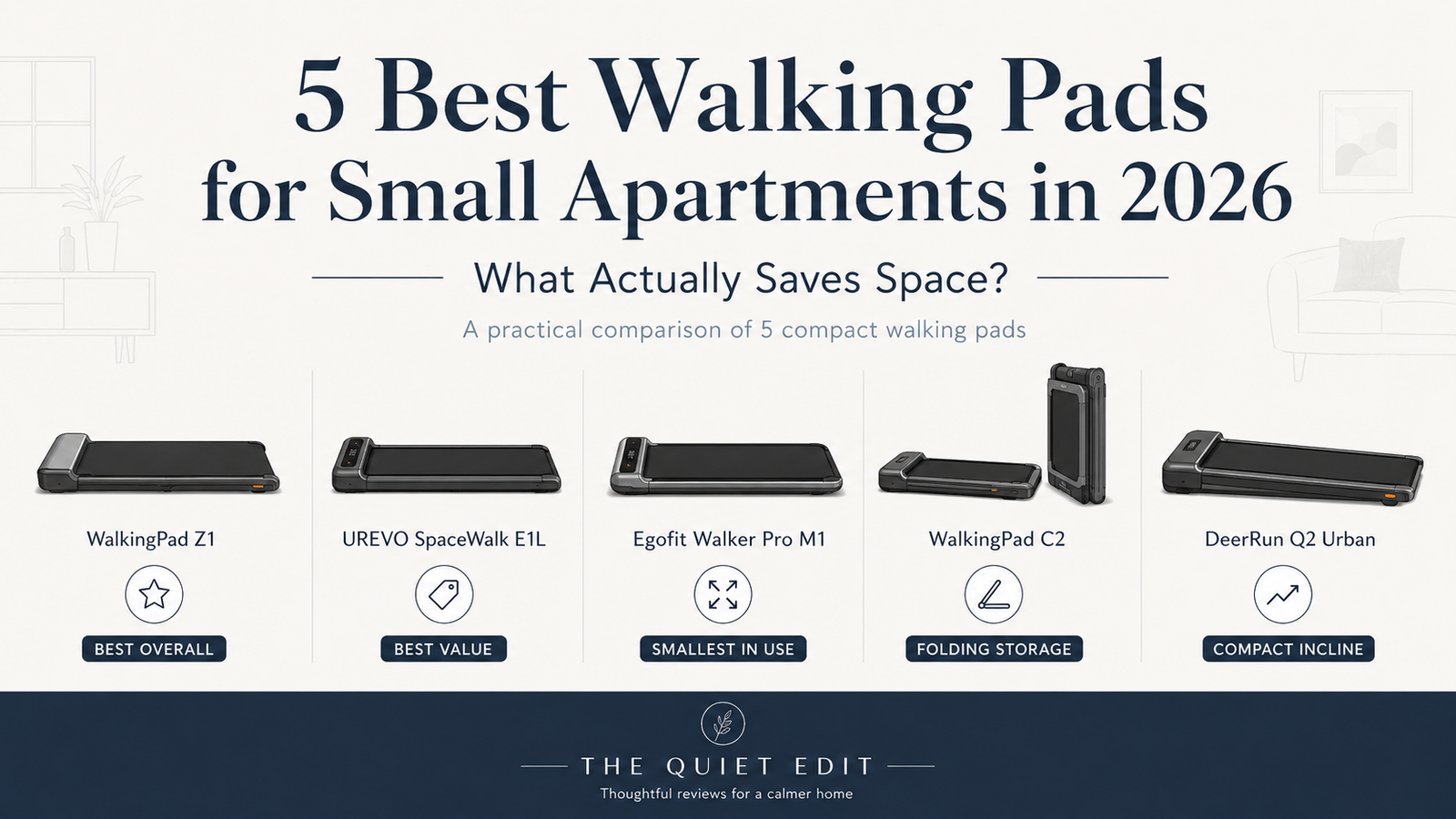
A walking pad can make far more sense than a full-size treadmill in a small apartment, but “compact” can mean several very different things.
One model might be tiny while you’re using it but awkward to store. Another might take up more floor space during a walk but fold down dramatically afterwards. A lightweight model may also be easier to live with than a technically smaller machine if you need to move it twice a day.
So when choosing the best walking pad for a small apartment, we think there are two spaces worth measuring: where you’ll use it and where you’ll store it.
Our picks focus on those practical differences rather than simply ranking motor power or feature counts.
Quick answer: The WalkingPad Z1 is our best overall pick because it combines a long walking area with a genuinely useful folding design and a lower price than the C2. The UREVO SpaceWalk E1L is our value pick, while the Egofit Walker Pro M1 has the shortest in-use footprint of the five models compared here.
How we chose: We have not personally tested these five walking pads. Our selections are based on current manufacturer specifications, product documentation, pricing, storage dimensions, and the practical implications of those figures for small-space living. Specifications and prices were checked in September 2026 and may change.
The Best Walking Pads for Small Apartments at a Glance
| Model | Our pick for | Size in use | Stored length | Weight | Walking area | Capacity | Current listed price* |
|---|---|---|---|---|---|---|---|
| WalkingPad Z1 | Best overall | 56.1″ long | 31.8″ folded | 51 lb | 47.6″ long | 242 lb | From $299 |
| UREVO SpaceWalk E1L | Best value | 42.1″ long | 42.1″ | 36.59 lb | 35.43″ long | 265 lb | $169.99 |
| Egofit Walker Pro M1 | Smallest in-use footprint | 38.39″ long | 38.39″ | 48.5 lb | 34.25″ long | 220 lb | $399 |
| WalkingPad C2 | Folding storage + longer strides | 56.9″ long | 32.5″ folded | 55 lb | 47.2″ long | 220 lb | $449 |
| DeerRun Q2 Urban | Compact option with incline | 42.62″ long | 42.62″ | 35.05 lb | 35.43″ long | 300 lb | From $119 |
*Prices shown on manufacturers’ US websites when checked in September 2026. Sales, colors, and variants can change the price.
WalkingPad lists the Z1 at 56.1 × 22 × 4.1 inches open and 31.8 × 22 × 5.4 inches folded, with a 47.6 × 15.7-inch walking area and 51-pound weight. Its grey version is currently $329, while the white version is discounted to $299.
UREVO currently lists the E1L at 42.1 × 19.3 × 4.2 inches and 36.59 pounds. Egofit lists the M1 at 38.39 × 21.85 × 6.89 inches and 48.5 pounds. DeerRun’s Q2 Urban is 42.62 × 19.69 × 3.94 inches and 35.05 pounds.
1. WalkingPad Z1
Best Overall for Small Apartments
The WalkingPad Z1 has one of the most useful combinations of dimensions in this group.
It’s not particularly small while you’re walking. At 56.1 inches long, it takes up considerably more floor space than the UREVO, DeerRun, or Egofit.
Then you fold it.
The Z1’s deck folds roughly in half, reducing its stored length to just 31.8 inches, the shortest stored length among these five models.
That wouldn’t be quite as interesting if WalkingPad had achieved it with a tiny walking belt. Instead, the Z1 provides a 47.6-inch-long walking area, also the longest of this group.
So you get room for a more natural stride while using it, without having to find nearly five feet of uninterrupted storage space afterwards.
That’s a particularly useful trade in a small apartment.
The Z1 weighs 51 pounds, so this is not the model we’d choose if carrying or repositioning your walking pad frequently is the priority. But built-in folding changes where you can store it in a way that shaving a few pounds doesn’t.
It also currently costs substantially less than the closely related WalkingPad C2. The grey Z1 is listed at $329, with the white version currently discounted to $299, while the C2 is listed at $449.
The catch: you still need 56.1 inches of floor length every time you use it. If your room itself is the problem rather than your storage space, one of the shorter models below may work better.
Our take: The Z1 is the most balanced small-apartment option here on paper. It doesn’t try to be the tiniest walking pad. Instead, it gives you a relatively spacious walking surface and then gets dramatically smaller when you’re finished.
2. UREVO SpaceWalk E1L
Best Value
The UREVO SpaceWalk E1L takes almost the opposite approach.
It doesn’t fold.
Instead, UREVO keeps the entire machine short, light, and relatively inexpensive.
The E1L measures 42.1 inches long and weighs 36.59 pounds, making it nearly 15 pounds lighter than the WalkingPad Z1. Transport wheels are built in, and UREVO specifically designs it to slide under suitable furniture.
For an apartment where you expect to pull the walking pad out each morning and put it away every evening, that weight difference matters.
The trade-off is underneath your feet.
Its walking area is 35.43 × 15 inches, roughly 12 inches shorter than the Z1’s.
That may be perfectly adequate for slower under-desk walking, but taller users or anyone with a longer natural stride should pay attention to the difference.
The E1L is currently listed at $169.99, which also puts it in a completely different price bracket from the two folding WalkingPad models. UREVO rates it for up to 265 pounds and a top speed of 4 mph.
The catch: if you don’t have somewhere to store a 42.1-inch-long machine, there’s no folding mechanism to solve the problem.
Our take: If the E1L already fits under your bed or sofa, paying hundreds more simply to make a walking pad fold may not improve your everyday experience very much.
For straightforward walking at a desk, this is the strongest value proposition of the five.
Already deciding between UREVO and WalkingPad? Read our
3. Egofit Walker Pro M1
Best for the Smallest In-Use Footprint
The Egofit Walker Pro M1 demonstrates why “smallest” needs a definition.
At only 38.39 inches long, it’s the shortest walking pad in this comparison while actually being used.
For a desk squeezed into a bedroom or a living room where every extra foot of floor space matters, that’s a serious advantage.
Egofit also builds in a fixed 5% incline, something none of the flat WalkingPad or UREVO models here offer. Maximum speed is lower at 3.11 mph, reinforcing that this is primarily an under-desk walking machine rather than something intended for faster exercise.
But here’s the important small-apartment catch:
The M1 is 6.89 inches tall.
Compare that with 4.2 inches for the UREVO E1L, 4.1 inches for the WalkingPad Z1 when open, and just 3.94 inches for the DeerRun Q2 Urban.
So the physically shortest machine may actually be harder to slide under low furniture.
This is exactly why shopping by the word “compact” alone can be misleading.
The M1 also has the shortest walking area here at 34.25 inches long, although it’s relatively wide at 16.54 inches. Its weight is 48.5 pounds and its published user capacity is 220 pounds.
The catch: very short length, but noticeably greater height and a short walking belt.
Our take: The M1 makes the most sense when your available floor length is the limiting factor and you like the idea of a built-in incline. Measure the clearance under your furniture before assuming it’s also the easiest to store.
4. WalkingPad C2
Best for Folding Storage and Longer Strides
The WalkingPad C2 shares the same core idea as our top-ranked Z1: give you a reasonably spacious walking deck while you’re using it, then fold the machine for storage.
Its walking area measures 47.2 × 15.7 inches, just fractionally shorter than the Z1’s.
Fold the deck and its overall length drops from 56.9 inches to 32.5 inches.
That still makes the C2 one of the easiest machines here to fit into storage spaces where uninterrupted length is scarce.
Why isn’t it our overall winner?
Mostly because the Z1 currently offers a remarkably similar small-space proposition for less money.
The C2 weighs 55 pounds versus 51 pounds for the Z1, has a rated capacity of 220 pounds versus 242 pounds, and currently costs $449 versus $299 to $329 for the Z1 depending on version.
The C2 does offer WalkingPad’s FootSense speed control and comes in a broader range of colors, so there are reasons someone could still prefer it. But those extras are harder to prioritize in a guide focused specifically on space and practical value.
There’s also an oddity worth knowing: WalkingPad’s own C2 pages have not always presented motor and speed specifications consistently. The current main specification page lists a 3 HP brushless motor and 1–4 mph range, while another indexed version of the official C2 page has shown 1 HP and a 3.7 mph maximum.
We therefore wouldn’t choose between the C2 and Z1 based on advertised horsepower.
The catch: it solves the storage problem extremely well, but currently asks a significant premium over the Z1.
Our take: Still an excellent design for small homes if you want its particular features or styling, but the Z1 currently makes the stronger value case.
5. DeerRun Q2 Urban
Best Compact Walking Pad with Incline
The DeerRun Q2 Urban packs a surprising amount into a very small body.
It measures 42.62 × 19.69 × 3.94 inches and weighs 35.05 pounds, making it the lightest walking pad in our comparison and also the thinnest while in use.
That alone makes it interesting for an apartment.
Then there’s the 7% manual incline.
Most walking pads this compact are completely flat. DeerRun combines that incline with a 35.43 × 14.96-inch walking belt, 0.6–3.8 mph speed range, built-in wheels, app connectivity, and a published 300-pound weight capacity.
At the time of writing, the black Q2 Urban is listed at $139 and the rose-gold version at $119 as part of a promotion. Those prices have already changed across previous DeerRun sales, so we’d pay far more attention to the current checkout price than to any permanent MSRP comparison.
DeerRun also publishes a motor-noise figure below 45 dB, although that’s a manufacturer claim rather than a standardized noise comparison against the other four models.
The catch: it doesn’t fold, its walking belt is relatively short, and its current price is heavily promotion-dependent.
Our take: On specifications alone, the Q2 Urban is an unusually strong package for apartment users who specifically want incline walking. We rank it more cautiously because its pricing and variants change frequently, making its long-term value proposition harder to pin down.
What Does “Small” Actually Mean for a Walking Pad?
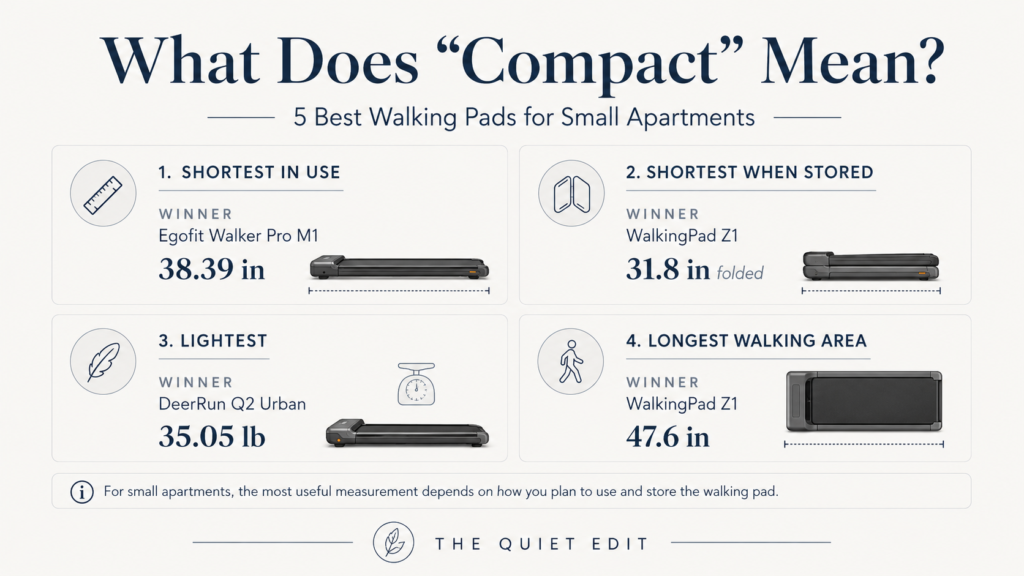
The five products above reveal something useful: there is no single dimension that determines whether a walking pad works in a small apartment.
The Egofit M1 is shortest while you’re using it, but also the tallest.
The WalkingPad Z1 and C2 are longest during use, but become the shortest machines here once folded.
The UREVO E1L doesn’t fold at all, yet weighs much less than either WalkingPad model.
And the DeerRun Q2 Urban is slightly longer than the UREVO, but it’s lighter, thinner, and adds an incline.
That’s why we’d measure three things before ordering:
- The floor space available while you walk.
- The exact space where the machine will live afterwards.
- The height underneath any bed or sofa you expect to use for storage.
A machine can win one measurement and lose another.
Which Walking Pad Should You Buy for a Small Apartment?
For most small apartments, we’d start with the WalkingPad Z1.
Its roughly 48-inch walking area is much more generous than the truly miniature options, yet its folding mechanism reduces the stored length to under 32 inches. That’s an unusually useful combination.
If budget matters more and you already have enough room to store a 42-inch machine, the UREVO SpaceWalk E1L is easier to justify financially and much lighter to move.
Choose the Egofit M1 when floor length while you’re walking is your biggest constraint.
Choose the WalkingPad C2 if you want WalkingPad’s folding concept and C2-specific features but don’t mind paying considerably more than the Z1.
And choose the DeerRun Q2 Urban if incline is important without giving up a slim, lightweight footprint.
The key is not finding the walking pad with the smallest number on a specification sheet.
It’s finding the one whose dimensions match the empty space you actually have.
Frequently Asked Questions
What is the best walking pad for a small apartment?
Based on current manufacturer specifications and pricing, our overall pick is the WalkingPad Z1. Its 47.6-inch walking area is relatively spacious, while the deck folds down to a stored length of just 31.8 inches.
What is the smallest walking pad?
Of the five models compared here, the Egofit Walker Pro M1 has the shortest overall length while in use at 38.39 inches. However, it’s 6.89 inches tall, so it may not fit underneath low furniture as easily as longer but thinner models.
Which walking pad is easiest to move?
By published product weight, the DeerRun Q2 Urban is the lightest in this comparison at 35.05 pounds, followed closely by the UREVO SpaceWalk E1L at 36.59 pounds.
Is a foldable walking pad better for a small apartment?
Not necessarily. Folding is particularly useful when storage length is limited. If you already have enough uninterrupted space under a bed or sofa, a lighter non-folding walking pad such as the UREVO E1L may be easier to live with day to day.
Can you run on these walking pads?
These five models are primarily walking machines. The WalkingPad Z1, C2, and UREVO E1L reach roughly 4 mph, DeerRun’s Q2 Urban reaches 3.8 mph, and the Egofit M1 tops out at 3.11 mph. Regular running calls for a treadmill designed for higher speeds, a longer running deck, and appropriate safety features.